




Launching a New Wave of Discovery
In 2025, APL led two ambitious NASA missions that pushed the boundaries of space science and exploration: the Interstellar Mapping and Acceleration Probe (IMAP) and the Electrojet Zeeman Imaging Explorer (EZIE).
On Sept. 24, IMAP launched from Kennedy Space Center aboard a SpaceX Falcon 9 rocket.
IMAP will study the heliosphere, the Sun’s magnetic bubble that shields our solar system, and help us develop a better understanding of space weather. IMAP is flying 10 instruments built by multiple organizations to study the solar wind, interstellar dust and other particles, magnetic fields, and ultraviolet light in space.
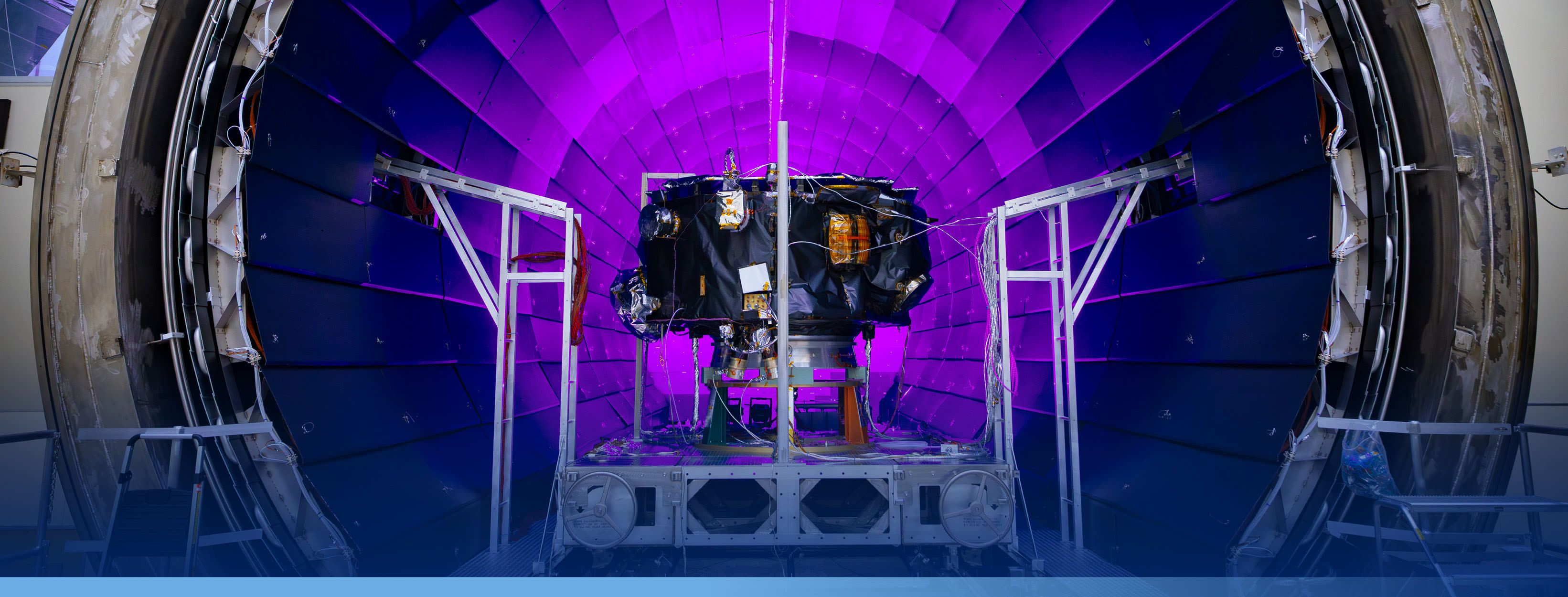
APL managed IMAP’s development phase, built the spacecraft, and operates it. Working with institutions from around the world, APL integrated IMAP’s instruments, subsystems, and components, thoroughly testing each one to ensure it would perform successfully in space.
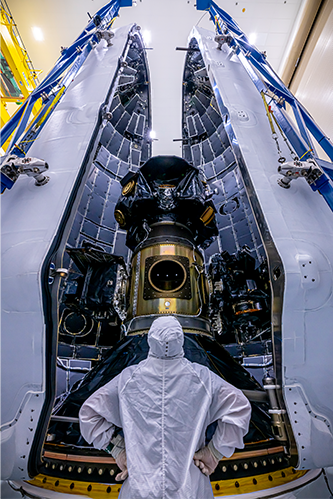
Anna Shin, an APL systems assurance manager, observes IMAP as it is encapsulated at the Astrotech Space Operations Facility, along with the Carruthers Geocorona Observatory and NOAA’s Space Weather Follow On–Lagrange 1 spacecraft, inside a SpaceX Falcon 9 payload fairing on Sept. 16, 2025. Credit: BAE Systems
Data from some of the spacecraft’s instruments will support the IMAP Active Link for Real-Time system, which will broadcast frequent and reliable information to enhance space weather predictions.
The IMAP mission will also help researchers learn more about the solar wind and energetic particles throughout the heliosphere. Even though they likely play a role in the presence of life in the solar system, these particles can adversely affect humans in space and harm technological systems.
About six months earlier, on March 14, the trio of small satellites that comprise the EZIE mission also launched aboard a SpaceX Falcon 9 rocket, this time from Vandenberg Space Force Base in California. During its 18-month mission, the EZIE trio is flying in a pearls-on-a-string formation approximately 260 to 370 miles (420 to 590 kilometers) above Earth’s surface.
Led by APL’s Sam Yee, the mission’s principal investigator, EZIE is determining the structure and evolution of Earth’s electrojets — the currents flowing through the ionosphere that electrically couple our planet’s magnetosphere to its atmosphere.
Electrojets — and their visible counterparts, auroras — arise when tremendous amounts of energy are transferred into Earth’s upper atmosphere from the solar wind, streams of electrically charged particles that flow from the Sun into the solar system. Mapping the electrojets will shed light on the physics behind Earth’s interaction with surrounding space — insights that will help us understand our own planet as well as any magnetized world in our solar system and beyond, while also improving our ability to predict space-weather events that can disrupt power grids, GPS, communications, and satellites people rely on every day.
“Through the IMAP and EZIE missions, APL is advancing our understanding of heliophysics,” said Robert D. Braun, head of APL’s Space Exploration Sector. “Together, these missions highlight what NASA, U.S. industry, and APL can achieve through strong partnerships and scientific excellence.”

“Through the IMAP and EZIE missions, APL is advancing our understanding of heliophysics. Together, these missions highlight what NASA, U.S. industry, and APL can achieve through strong partnerships and scientific excellence.”
—Robert D. Braun, APL’s Space Exploration Sector Head
APL leads the mission for NASA. NASA’s Jet Propulsion Laboratory in Southern California built each satellite’s sole instrument, the Microwave Electrojet Magnetogram, and Blue Canyon Technologies in Boulder, Colorado, provided the spacecraft, marking another successful partnership between APL and a commercial space firm.
Following the successful EZIE launch, NASA selected Dartmouth College and APL to begin developing the Cross-scale Investigation of Earth’s Magnetotail and Aurora (CINEMA) mission, which will shed more light on the growing impacts of space weather by unlocking the secrets of the energy circulation through Earth’s magnetotail.
Using a constellation of nine small satellites carrying three science instruments each, CINEMA will provide the most comprehensive view to date of the magnetotail and aurora and their roles in magnetospheric dynamics, including how energy is released and solar particles move through Earth’s magnetic field, and reveal how storms on the Sun can trigger effects that reach all the way to the technologies we use on Earth. Dartmouth College serves as the principal investigator institution, with APL managing the mission, providing critical instrumentation, and integrating the payload.
The Dragonfly mission, which APL leads and manages for NASA, also made significant strides toward launch with the successful completion of its Critical Design Review in April. Components for the car-sized, nuclear-powered rotorcraft and its scientific instruments — which will assess Titan’s habitability and search for the chemical building blocks of life as we know it — have been built and are undergoing rigorous development and test campaigns. The campaigns include aerodynamic wind-tunnel testing of Dragonfly’s rotors in Titan-like conditions and performance verification of the mass spectrometer and other instrument sensors. The larger integration and testing campaign is set to begin in early 2026, keeping the mission on track for launch in 2028 and Titan arrival in 2034.
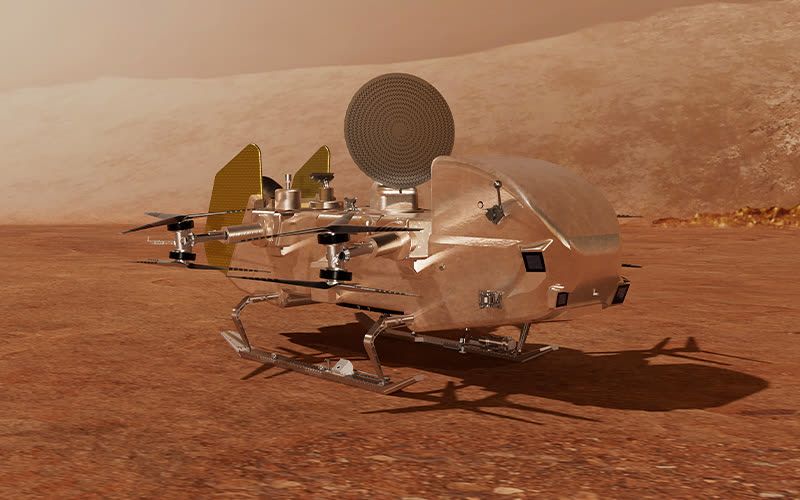
An artist’s rendering shows NASA’s Dragonfly rotorcraft at a landing site on Saturn’s moon Titan.
APL’s next giant civil space leap, Dragonfly, embodies a game-changing approach to visiting other worlds in our solar system, pushing the boundaries of planetary exploration with a flying science laboratory that will take advantage of Titan’s low gravity and dense atmosphere to examine sites across the moon’s diverse surface. Over an approximately three-year primary mission, Dragonfly will make repeated flights to dozens of geologic sites, collecting and analyzing samples to investigate the chemical processes that may resemble those that led to life on Earth.
Throughout 2025, APL also engaged a broader set of government and commercial space partners, expanding its national impact to complement larger programs such as Dragonfly and IMAP. These efforts span a targeted set of focus areas, including cislunar infrastructure and lunar surface systems, space weather missions including analysis and forecasting, and planetary defense. Many of these projects are pursued in close collaboration with civil and national security sponsors and industry partners, enabling rapid technology maturation while advancing shared understanding of the space environment. Together, these partnerships enhance APL’s technical depth, strengthen its role across the space ecosystem, and ensure continued impact to the nation in an increasingly dynamic space domain.