From the seas to the skies, cyberspace, and deep space, the challenges facing U.S. forces today span every domain. Whether enabling rapid planning for fleet protection, strengthening air and missile defenses, or advancing electronic warfare capabilities, APL applies deep technical expertise to design, integrate, prototype, and accelerate capabilities that help the nation anticipate threats and act decisively — making critical contributions toward a more agile, resilient, and integrated national defense posture.
Innovation and technology are reshaping the nature of competition and conflict, blurring the boundaries between physical, digital, and biological threats. APL fuels the nation’s ability to stay ahead of these shifts by identifying vulnerabilities and developing solutions that strengthen security, defense, and resilience. From hypersonics and autonomy to biotechnology and infrastructure protection, the Laboratory is integrating science, engineering, and analysis to anticipate and counter tomorrow’s threats today.
Today’s national security challenges demand rapid innovation, a call APL is answering by actively engaging commercial
partners from across industries to identify and leverage their capabilities, manufacturing capacity, and cutting-edge
research — while remaining an independent, trusted partner to the government. By combining its deep technical expertise
and mission understanding with industry’s ability to rapidly scale emerging capabilities, APL helps bridge the gap between
early-stage research and accelerating operationally relevant solutions.
APL is redefining how artificial intelligence (AI), materials, manufacturing, and biology accelerate innovation for national defense and beyond. Through forward-leaning research, Laboratory researchers are exploring bold new concepts that may not reach the field immediately but are critical in shaping what comes next. By laying the groundwork for more resilient systems, faster innovation cycles, and transformative capabilities, APL is advancing the most innovative and effective technologies into real-world application and strengthening the nation’s technological advantage.
APL’s mission to solve complex challenges drives discoveries across extreme frontiers — from the blazing atmosphere of the Sun to the deepest Arctic oceans and the icy moons of the outer solar system. APL spacecraft, sensors, and scientific instruments are revealing how solar physics and space weather impact our world, while parallel efforts on Earth are shaping technologies to sustain human and robotic exploration and operations in extreme environments.
From incubating bold research proposals and developing the next generation of leaders to building collaborative
workspaces, APL fuels creativity and novel ideas at every level.
With a large portfolio of cutting-edge intellectual property and a team of experienced licensing staff, APL’s Tech Transfer offers streamlined access to technological innovations made at the Laboratory.
APL’s strategic collaborations with other Johns Hopkins University (JHU) divisions strengthen the Lab’s ability to tackle the nation’s most complex technical challenges. Working alongside university researchers, faculty, and students, APL experts transform foundational research into real-world solutions while providing technical and strategic guidance at the intersection of academia, industry, and government. These partnerships leverage the expertise of a world-class research institution to accelerate innovation, educate the current and future workforce, and develop impactful technologies that address national priorities.
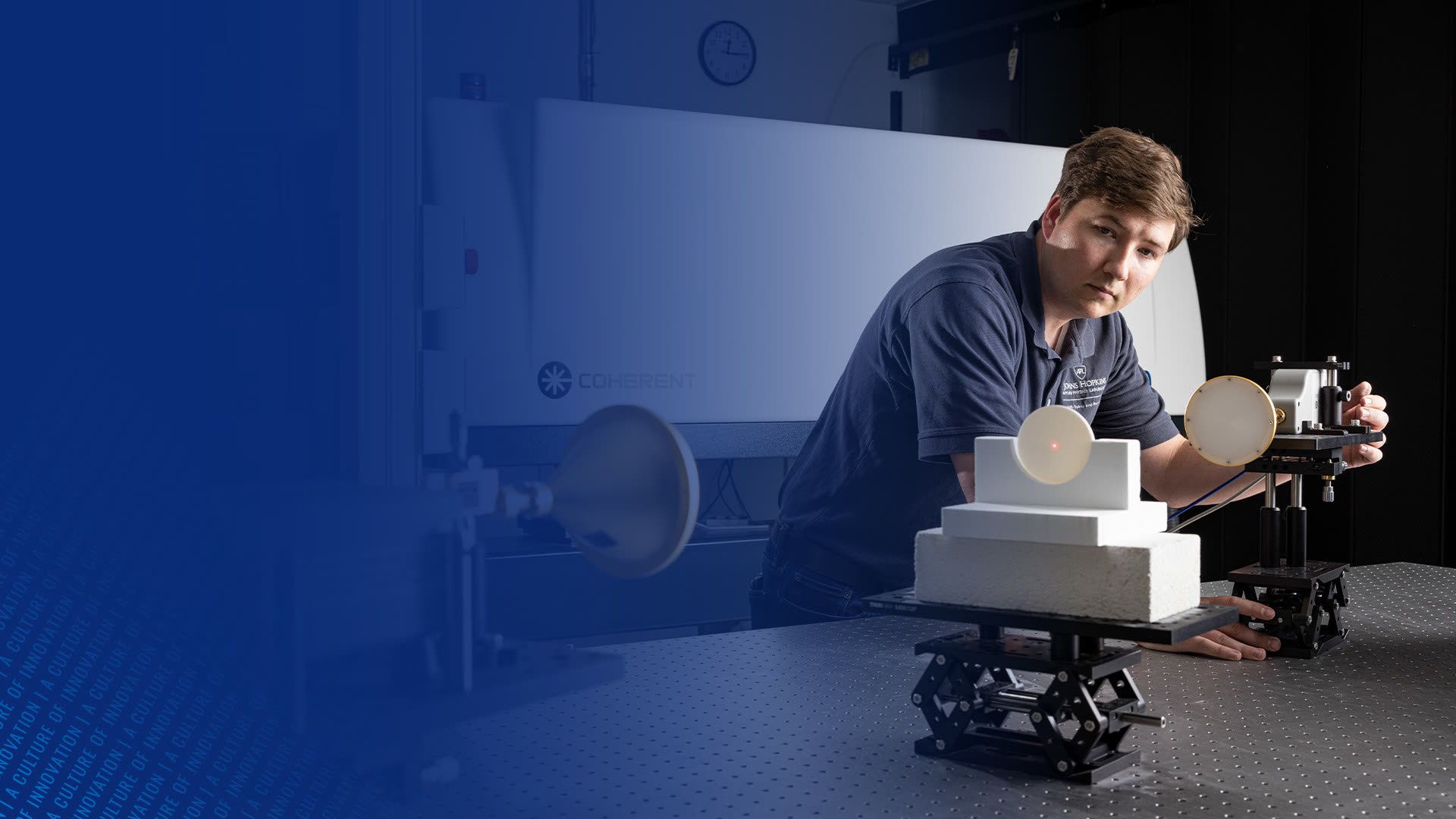
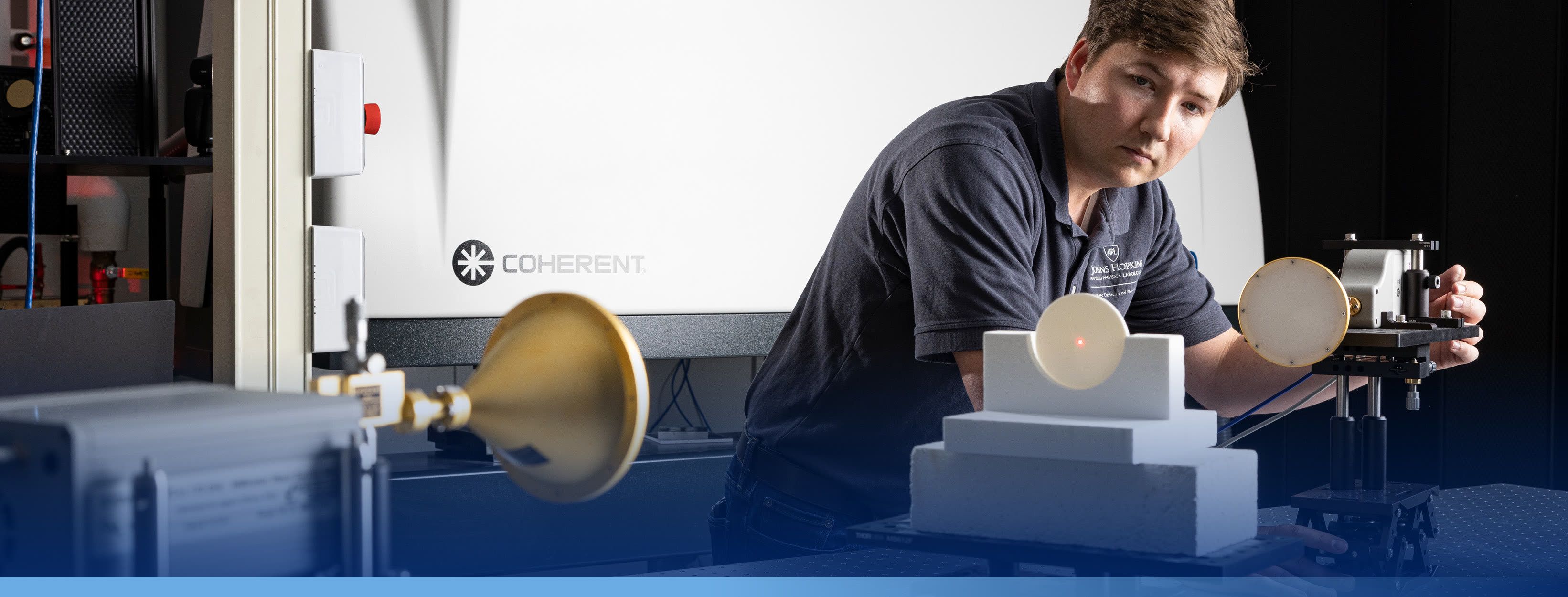
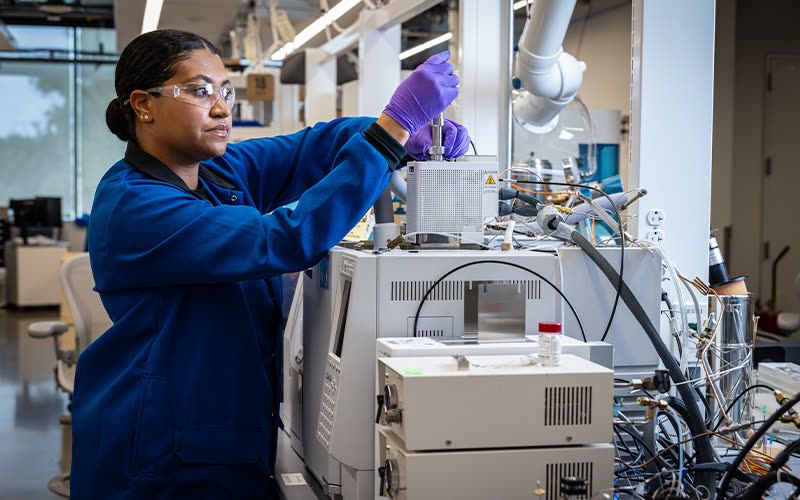
Andy Goers, an APL optical physicist, works in the Hypersonic Optical Test Lab. This facility is a versatile space where APL researchers use a high‑power CO₂ laser, infrared pyrometry cameras, wavefront sensors, and a boresight‑error testbed to evaluate and characterize advanced hypersonic materials and coating concepts.
A Culture of Innovation
From incubating bold research proposals and developing the next generation of leaders to building collaborative workspaces, APL fuels creativity and novel ideas at every level.
APL’s emphasis on innovation lays the groundwork for capabilities that deliver value to sponsors. Purpose-built lab spaces enable teams to explore high-risk ideas, mature emerging technologies, and rapidly transition successful concepts into sponsor-ready solutions. To complement this infrastructure, the Lab sustains a portfolio of strategic investments to foster innovative approaches, catalyze new ideas, and accelerate their path from concept to impact. The Independent Research and Development (IRAD) program, Project Catalyst, and Janney Grants are three key programs in this portfolio.
IRAD
The IRAD program is a cornerstone of innovation at APL, enabling the Lab’s 13 mission areas each year to pursue high-impact, mission-relevant research and development with the potential to address critical national challenges. Spanning basic research through system concept formulation, IRAD projects mature promising technologies into novel capabilities that can transition to sponsors and deliver real-world mission impact. The process is highly competitive. Roughly 1,600 IRAD proposals were submitted in 2025, and more than 400 were funded. Some of the most impactful IRADs from 2025 include:
Discovery of infrared Transparent Materials (DIRT)
The hypersonic community requires infrared-transparent window materials that can withstand the extreme thermal environments encountered at speeds exceeding Mach 5, yet few materials meet both performance and manufacturability requirements. To address this gap, APL researchers developed a generative artificial intelligence (AI) platform that enables rapid design, synthesis, and testing of new high-temperature optical materials, dramatically speeding up development of advanced, heat-resistant windows for hypersonic and related applications.
Increasing Fleet Readiness with Digital, Cyber Secure Advanced Manufacturing tools
Electronic component failures are the leading cause of fleet outages in critical warfighting systems, which are often compounded by long lead times and limited design and repair documentation. Aerosol-jet-based advanced electronics manufacturing offers an emerging solution, enabling rapid fabrication and deployed repair of printed circuit boards. Working with the original equipment manufacturer, APL developed an Electronics Advanced Manufacturing (eAM) machine by modifying an HD2 aerosol jet additive printer to integrate subtractive and post-processing capabilities into a single, user-friendly system.
The Lab also developed the Agile Manufacturing eXchange (AMX), which is compatible with the Navy advanced manufacturing environment, to provide the digital tools and data required for a minimally trained technician to manufacture at the point of need. The eAM machine was connected to the AMX to remotely deliver the capability to complete complex electronic repairs without having to deploy an expert. This capability is the culmination of four years of work to reimagine the repair of complex systems at the edge.
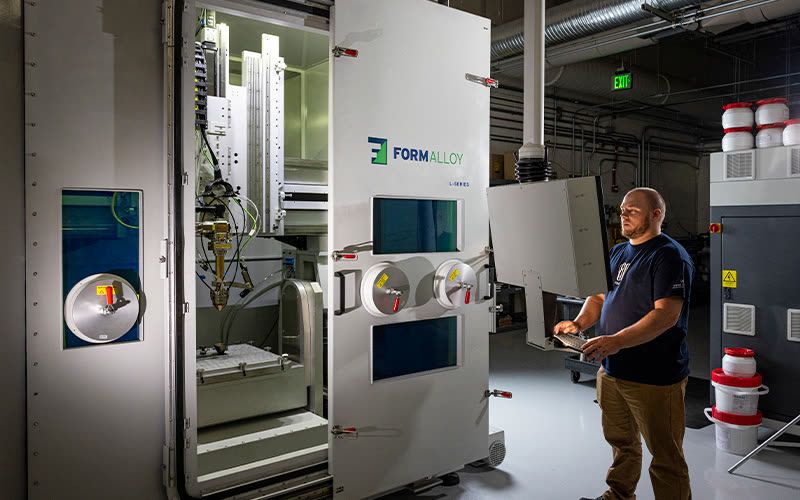
Bobby Mueller, an additive manufacturing process engineer, operates a FormAlloy metal 3D printer in APL’s Advanced Manufacturing Facilities.
Advanced Manufacturing Facilities
APL’s Advanced Manufacturing Facilities encompass approximately 95,000 square feet and provide end-to-end, AS9100-certified capabilities to develop mission-ready hardware for classified and unclassified programs. By integrating design, fabrication, testing, and assembly, the labs enable teams to rapidly transition concepts into qualified systems for applications ranging from deep-ocean platforms to spaceflight.
Contextual Alert Risk Prioritization (CARP)
CARP is a machine learning system APL designed and prototyped to optimize alert handling inside Navy cyber-defense platforms. The tool works by analyzing alerting trends, identifying patterns, and considering mission context to prioritize alerts and ensure that high-risk threats receive immediate attention. This approach significantly boosts the efficiency and effectiveness of cyber defenders, enabling them to rapidly detect and respond to critical security incidents. In testing, CARP matched human expert alert rankings better than baseline and state-of-the-art techniques.
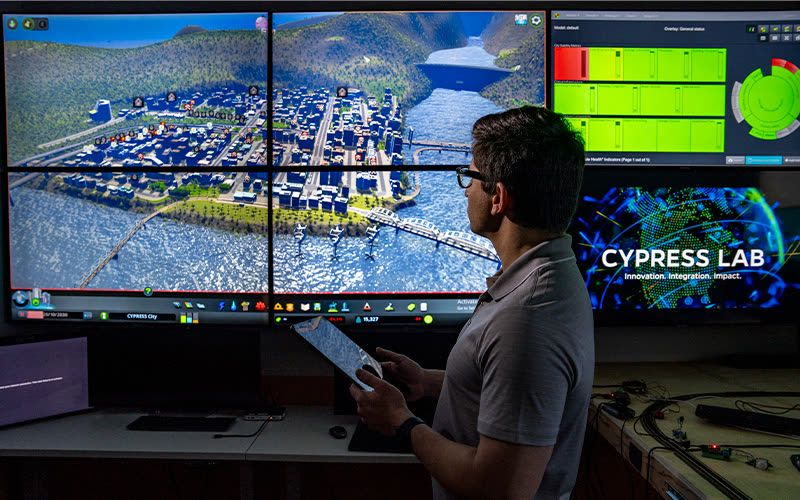
An engineer monitors a simulated urban environment in APL’s CYPRESS Lab, where integrated digital displays connect industrial control system testbeds, enabling engineers to study how cyberattacks, defenses, and recovery strategies affect interconnected critical infrastructure.
CYPRESS Lab
Cyber-Physical Resilient Systems Solutions (CYPRESS) is a laboratory at APL with small-scale industrial control systems and associated equipment. The facility has both water and power environments. CYPRESS has been critical to the development of cybersecurity mitigations and has accelerated critical infrastructure cyber defense against Volt Typhoon.
Project Catalyst
Project Catalyst is a Lab-wide science and technology grant program that provides staff funded opportunities, sometimes over multiple years, to test critical assumptions, investigate phenomena, and push the boundaries of knowledge and what is possible. Since its launch, the program has awarded nearly 700 grants ranging from $10,000 to $500,000, with 77 grants awarded in FY 2025 alone.
Project Catalyst in Action: Neural Networked Clock Ensemble for Coherent sensing
APL developed an ultrastable, low-SWAP (size, weight, and power) timing solution that improves oscillator performance by two to three orders of magnitude among spatially distributed radar receivers. This capability supports next-generation multisatellite synthetic aperture radar architectures, delivering higher-resolution 3D imaging and more precise motion measurement that directly boost target identification, battle-space awareness, and rapid decision-making in contested missions while enabling more flexible, resilient, and scalable radar constellations using conventional radio frequency links.
Janney Grants
APL’s Janney Grants empower staff to engage and collaborate with the broader science and technology ecosystem, both domestically and globally. A key part the Lab’s overall strategy, this collaboration helps APL maintain awareness of emerging technologies and stay on the cutting edge of key competency areas for sponsors.
Janney Grants in Action: AI Imaging for Dual-Use applications
Chiman Kwan, an electrical engineer and IEEE fellow — received a Janney Grant to collaborate with Professor Julia Chung at National Cheng‑Kung University in Taiwan. The partnership focused on advancing AI and machine learning algorithms for medical imaging analysis, with planned transition of these techniques to missile detection applications.
(From left) APL staff members David Casselbury, Marie Chau, and Neil Joshi are using AI to monitor the use of 3D printers to create nefarious objects.
Central Spark
Central Spark is APL’s 24/7 innovation space, supporting rapid experimentation and cross-sector collaboration with minimal barriers. The 9,000-square-foot facility combines tools for rapid fabrication, electronic circuitry, virtual and augmented reality, and human-centered design, and it supports more than 3,000 staff visits each week. Work in Central Spark ranges from exploratory concepts to applied solutions, including a Janney-funded project that used machine learning to flag potentially harmful 3D-printable designs — and demonstrated how the space enables creativity and responsible innovation.
Innovation Infrastructure
Making critical contributions requires taking risks and running experiments — work that is best done in labs and technical facilities. APL has created and maintains several specialized facilities, many of which are unique in the nation. Here are some of APL’s notable research and collaboration spaces:
Ralph D. Semmel Center for Innovation
Named in honor of Director Emeritus Ralph Semmel, the Semmel Center is a 263,000-square-foot research facility designed to spark innovation and collaboration in mission-related research and development. It offers 90,000 square feet of laboratory space for advanced materials, biotechnology, quantum science, power and energy technologies, and microelectronics, as well as reconfigurable work areas for more than 650 scientists and engineers.
Researchers work inside the Ralph D. Semmel Center for Innovation, a 263,000-square-foot facility designed to foster collaboration across disciplines and accelerate mission-driven research in areas including advanced materials, biotechnology, quantum science, and microelectronics.
Linear Accelerator Facility
The 4,000‑square-foot Linear Accelerator (LINAC) Facility houses a 25 MeV S‑band accelerator, a heavily shielded hall, a radiochemistry lab, and a dedicated Controlled LINAC Irradiation of Quantum Experiments test stand with a dilution refrigerator that cools samples to ~10 mK. This is the first and only facility in the world that has coupled an electron accelerator and a dilution refrigerator, making it an ideal place to study radiation effects in quantum computing devices.
Biosafety Lab
APL’s Biosafety Level 3 laboratory is a 2,400-square-foot space for conducting research in bacteriology, virology, bioaerosol sciences, genomics, nanoparticle science, and more. The facility is the largest active chamber of its kind in the country, enabling recapitulation of the natural environment and allowing accurate testing and measurement of the physical, biological, and chemical properties of live agents.
Combat Systems Cyber Warfare Analysis Lab (CSCWAL)
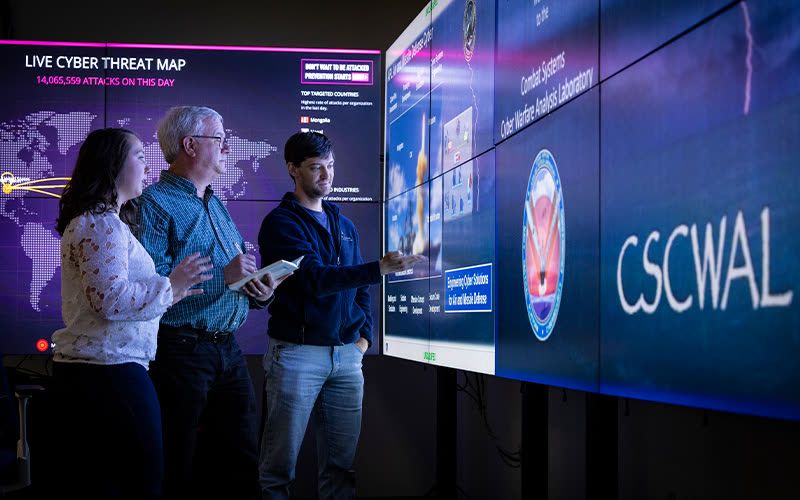
This laboratory provides a stand-alone classified environment for the development, integration, and testing of cyber capabilities to support air and missile defense systems. The lab serves as the primary space for testing cyber effects, evaluating and validating cyber vulnerabilities, and developing cyber defense systems against nation-state adversaries. Because of the unique nature of CSCWAL and the array of capabilities available, APL has been able to provide several significant contributions to our sponsors.
APL staff members focus on a live dashboard in CSCWAL. From tabletop risk assessment drills to rapid prototyping of cyber defense concepts, this facility enables end-to-end work — design, testing, integration, and fielding of secure systems; supply chain hardening; reverse engineering of threats; and software assurance — so national security capabilities stay protected.
Satellite Communication Facility
Established in 1961 to support the command and telemetry requirements of the world’s first satellite navigation system under contract to the U.S. Navy, the APL Satellite Communications Facility has provided support for a broad range of spaceflight missions for more than six decades. The facility consists of two independent operational antennas, one at 16 feet (5 meters) and another at 60 feet (18.3 meters). It offers commanding, ranging, telemetry, and Doppler tracking services for spacecraft missions in locations ranging from low Earth orbit to deep space, with a communications range approximately 2.5 times the average distance between Earth and the Sun.
10,000-Gallon Saltwater Test Tank
This 10,000-gallon test tank serves as a controlled setting for evaluating maritime sensors and platforms and accelerating the integration and testing of new remotely operated vehicle technologies. The salinity of the tank is maintained to match the area of interest in the ocean to enable testing where density, conductivity, and corrosion are important.