






Director’s
Message

Defending
the Nation

From the seas to the skies, cyberspace, and deep space, the challenges facing U.S. forces today span every domain. Whether enabling rapid planning for fleet protection, strengthening air and missile defenses, or advancing electronic warfare capabilities, APL applies deep technical expertise to design, integrate, prototype, and accelerate capabilities that help the nation anticipate threats and act decisively — making critical contributions toward a more agile, resilient, and integrated national defense posture.

Countering
Evolving
Threats

Innovation and technology are reshaping the nature of competition and conflict, blurring the boundaries between physical, digital, and biological threats. APL fuels the nation’s ability to stay ahead of these shifts by identifying vulnerabilities and developing solutions that strengthen security, defense, and resilience. From hypersonics and autonomy to biotechnology and infrastructure protection, the Laboratory is integrating science, engineering, and analysis to anticipate and counter tomorrow’s threats today.

Accelerating
Progress

Through
Partnerships

Today’s national security challenges demand rapid innovation, a call APL is answering by actively engaging commercial partners from across industries to identify and leverage their capabilities, manufacturing capacity, and cutting-edge research — while remaining an independent, trusted partner to the government. By combining its deep technical expertise and mission understanding with industry’s ability to rapidly scale emerging capabilities, APL helps bridge the gap between early-stage research and accelerating operationally relevant solutions.

Bold
Innovation

APL is redefining how artificial intelligence (AI), materials, manufacturing, and biology accelerate innovation for national defense and beyond. Through forward-leaning research, Laboratory researchers are exploring bold new concepts that may not reach the field immediately but are critical in shaping what comes next. By laying the groundwork for more resilient systems, faster innovation cycles, and transformative capabilities, APL is advancing the most innovative and effective technologies into real-world application and strengthening the nation’s technological advantage.

Exploring
The Extremes

APL’s mission to solve complex challenges drives discoveries across extreme frontiers — from the blazing atmosphere of the Sun to the deepest Arctic oceans and the icy moons of the outer solar system. APL spacecraft, sensors, and scientific instruments are revealing how solar physics and space weather impact our world, while parallel efforts on Earth are shaping technologies to sustain human and robotic exploration and operations in extreme environments.

A Culture
of Innovation

From incubating bold research proposals and developing the next generation of leaders to building collaborative workspaces, APL fuels creativity and novel ideas at every level.

Tech
Transfer

With a large portfolio of cutting-edge intellectual property and a team of experienced licensing staff, APL’s Tech Transfer offers streamlined access to technological innovations made at the Laboratory.

University
Collaborations

APL’s strategic collaborations with other Johns Hopkins University (JHU) divisions strengthen the Lab’s ability to tackle the nation’s most complex technical challenges. Working alongside university researchers, faculty, and students, APL experts transform foundational research into real-world solutions while providing technical and strategic guidance at the intersection of academia, industry, and government. These partnerships leverage the expertise of a world-class research institution to accelerate innovation, educate the current and future workforce, and develop impactful technologies that address national priorities.

Countering
Evolving
Threats

Evolving threats cross domains, from hypersonic weapons and autonomous systems to cyberattacks and biological hazards. APL integrates sensing, analytics, and mission engineering to help sponsors anticipate risks, strengthen defenses, and improve resilience.

Demonstrating and Hardening Hypersonics

The United States faces significant technical challenges in developing and fielding effective hypersonic weapon systems, an essential technology in today’s contested operating environment and a critical difference-maker in the nation’s ability to project power and protect itself and its allies against a new generation of threats.

From basic aerodynamic research to innovative technology development, APL is driving multiple technical improvements that are vital to the effectiveness and survivability of the nation’s offensive and defensive hypersonic capabilities. The cutting-edge technologies conceived of and developed by APL are critical to operational concepts supporting national priorities such as the Golden Dome for America missile defense system, operational needs in the U.S. Indo-Pacific Command (INDOPACOM) theater, and ensuring survivable reentry vehicles against increasingly capable adversary defenses. The Laboratory leads projects that advance the state of the art in guidance, navigation, and control of these vehicles; validate the tools used to predict vehicle aerodynamics and aerothermodynamics, including boundary layer transition; and create materials capable of withstanding the extreme thermal environment.

Drawing on the Lab’s extensive domain expertise, APL pioneered complex kill chains to engage dynamic targets; is driving the transition of hypersonic boost-glide technology into a successfully flight tested, operationally capable strike weapon system; and is enabling industry development of the world’s first operational glide-phase hypersonic defense capability. Additionally, APL is creating novel high-temperature materials and manufacturing approaches to enable survival of tactical hypersonic weapons, strategic hypersonic payloads, and hypersonic kill vehicles, as well as creating technologies that will ensure the survivability of future strategic reentry payloads. In each application space, APL is a key driver in identifying and mitigating the highest technical risk areas through rigorous design, modeling and simulation, prototyping, and testing. The Lab also matures the effectiveness and reliability of these critical technologies before transitioning them to industry partners to meet sponsor needs.

From hypersonic capabilities for tactical and strategic systems, APL is accelerating the development, implementation, and fielding of these essential technologies.

As examples, in 2025, the Laboratory:

  • Developed a kill chain architecture for long-range fires used operationally by the U.S. Navy, Air Force, and Army, combining multiple novel capabilities, which have been exercised in the INDOPACOM theater.
  • Delivered Conventional Prompt Strike Mission Planning tools that accelerated the deployment of hypersonic strike capabilities for the U.S. Army and the Navy through the success of an end-to-end flight test of the Army’s Rapid Capabilities and Critical Technologies Office’s conventional hypersonic missile.
  • Created low-cost, high-performance, oxidation-resistant, high-emissivity leading-edge coatings that passed extensive arcjet testing and were successfully flight tested on sounding-rocket experiments in 2025.
  • Designed, prototyped, and delivered advanced reentry technologies — including hardware demonstrating thermal protection system advanced materials — as part of investment by the Department of War (DOW) in modernization and recapitalization of the nation’s ballistic missile forces.
  • Developed and demonstrated an integrated simulation to incorporate countermeasure modalities into a multifunctional payload to demonstrate compelling effectiveness against adversary threat systems and is finalizing requirements for platform integration.
  • Identified future capabilities for the Air-Launched Rapid Response Weapon (ARRW) through multi­disciplinary engineering trade studies leveraging APL’s deep knowledge of the ARRW system and analytical tools, developing a clear path forward for both production and further development of advanced capabilities for ARRW.
  • Predicted end-to-end flight performance of the Hypersonic Attack Cruise Missile and partnered with industry, simultaneously enabling the program to pass through Critical Design Review and reducing risk during critical phases of flight.

U.S. Navy and Japan Maritime Self-Defense Force ships operate together in the Philippine Sea during a large-scale exercise that integrates joint and allied forces across multiple domains. These opportunities enable APL to perform advanced mission planning and technical analysis to help sponsors assess and field capabilities for operating in contested environments, including hypersonic-related missions and defenses. Credit: U.S. Navy
Advancing Autonomous Systems and Countering Drone Threats

As autonomous systems grow more capable and widespread, APL is advancing tools and architectures that can defend against adversarial threats and improve assets warfighters rely on to complete missions across land, sea, and air.

On the Ground:

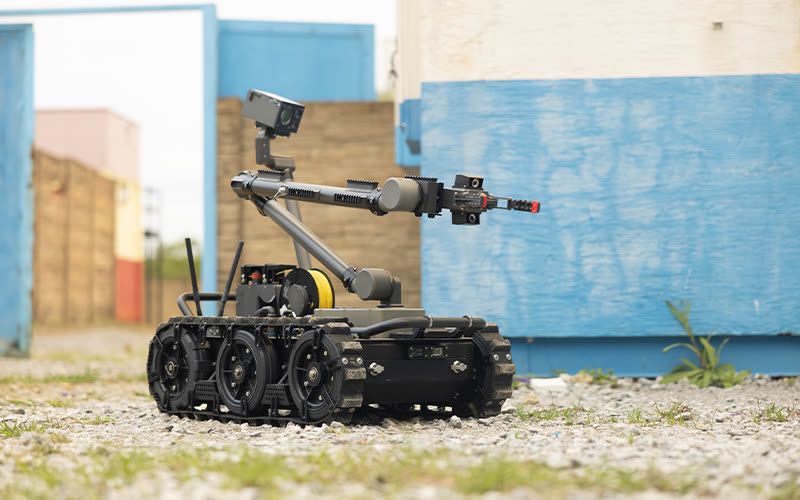
APL is collaborating with the U.S. Army and Navy to develop autonomous technologies that clear large areas of unexploded ordnance and other hazards. APL is adapting sensor compute systems developed under prior Office of Naval Research and U.S. Army Ground Vehicle Systems Center efforts for integration with a widely used explosive hazard-mitigation platform known as the Man Transportable Robotic System (MTRS). This effort aims to enable autonomous navigation, standoff detection, and scalable hazard clearance over operational surfaces such as airfields. The team is leveraging proven simultaneous localization and mapping technologies to equip MTRS with robust autonomous navigation capabilities.

APL is advancing autonomy and sensing that help warfighters detect and mitigate explosive hazards using fielded robotic platforms such as the Man Transportable Robotic System Increment 2, shown here during an explosive ordnance disposal field exercise at Camp Hansen, Okinawa, Japan. Credit: U.S. Marine Corps

In Austere Environments:

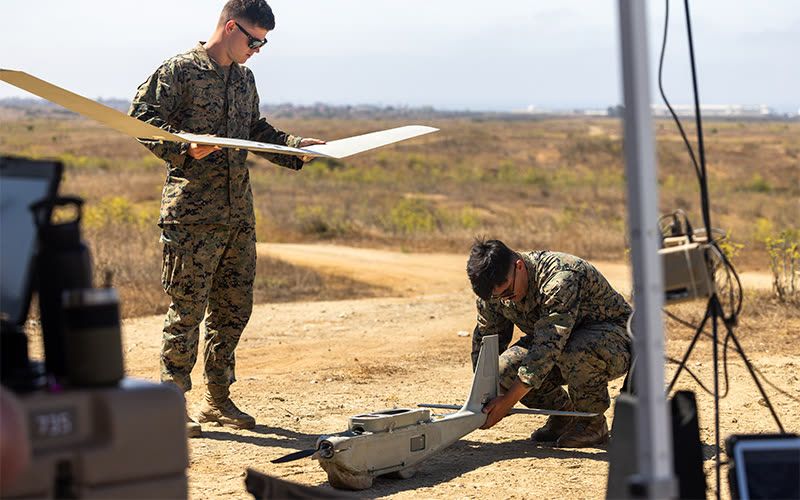
Dead Center is a low-SWaP (size, weight, and power) tactical-edge automated target recognition (ATR) and mission-level autonomy solution that enables users to build and deploy custom autonomous missions and manage custom ATR algorithms in austere, disconnected environments. It is one of DOW’s pioneering efforts in low-SWaP tactical-edge autonomy and ATR agility for full-motion video and synthetic aperture radar. APL delivered Dead Center systems to several Marine Corps units for operational use, and systems will be delivered at scale for small unmanned aerial system utilization as part of a Program of Record for the Marine Corps.

Dead Center is an APL-developed low‑SWaP artificial intelligence system that performs real‑time onboard target detection on autonomous platforms, sending only concise data to reduce bandwidth and enable fully autonomous intelligence, surveillance, and reconnaissance missions. Marines with 1st Light Armored Reconnaissance Battalion train with Dead Center at Camp Pendleton in August 2025. Credit: U.S. Marines

On the Seas:

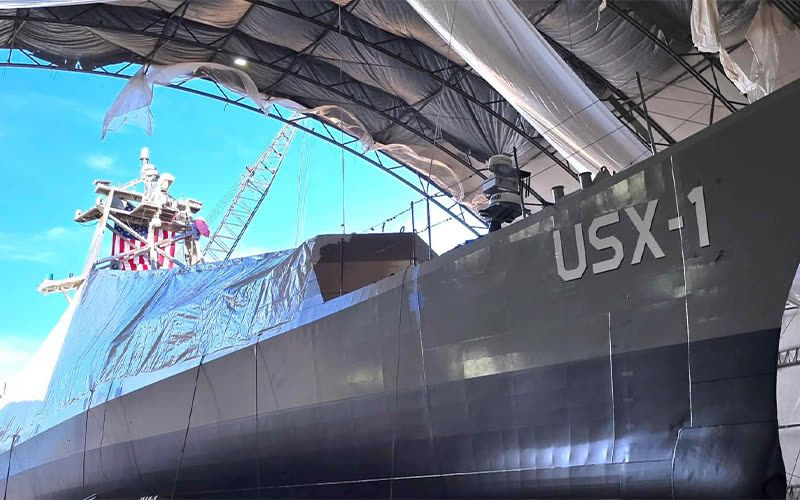
APL is integral in ensuring the Defense Advanced Research Projects Agency’s (DARPA) No Manning Required Ship (NOMARS) — set to become a first-of-its-kind, fully autonomous medium-sized ship — will demonstrate extended autonomous operation at sea. For NOMARS to execute long missions at sea without human intervention, the vessel requires novel hardware and software solutions for onboard executive autonomy, machinery configurations, propulsion, and control schemes. The Lab led test and evaluation of the ship’s autonomy software by defining the core autonomy architecture and conducting iterative simulation testing on the autonomy and perception software to validate performance. Early in the program, the Lab also helped define the list of functional requirements, international regulations, and domestic and Navy-recommended certifications that the vessel will meet. The experimental NOMARS vessel — the USX-1 Defiant, designed and built by Serco Inc. — was christened in August 2025 and is scheduled to undergo rigorous and extensive testing ahead of a three-month at-sea demonstration period before a planned transition to the Navy’s Unmanned Maritime Systems Program Office (PMS 406).

APL led test and evaluation of the experimental vessel USX-1 Defiant’s autonomy software. The ship supports DARPA’s No Manning Required Ship (NOMARS) program and is set to become a first-of-its-kind, fully autonomous, medium-sized vessel capable of extended operations at sea. Credit: DARPA

In the Skies:

During the Falcon Peak exercise for counter-unmanned aircraft systems (UAS) hosted by U.S. Northern Command (USNORTHCOM) and North American Aerospace Defense Command (NORAD), APL presented a new drone-defense system, called Skyward, designed to protect infrastructure and citizens in the homeland as well as U.S. warfighters and interests worldwide. Skyward is a decision-support tool for defense operators that offers a real-time threat assessment and course-of-action recommendation for each drone it detects. At the exercise, APL seamlessly integrated Skyward with commercially available sensors and USNORTHCOM’s drone sensor fusion solution, the Advanced Tactical Hostile Engagement Awareness (ATHENA) toolkit.

Falcon Peak 25.2 featured tests and demonstrations of counter-UAS systems, including APL’s Skyward decision-support tool and a range of commercial sensors, like the one pictured above. Credit: Department of War

Golden Horde: Networked and Collaborative Autonomy

In 2021, the Air Force Research Laboratory (AFRL) selected APL as the technical lead for the Golden Horde program, a pioneering prototyping effort focused on developing a digital, agile, open, and government-owned research and development testbed capability for networked, collaborative, and autonomous (NCA) weapon technologies.

Participants gathered in APL’s Semmel Center to participate in a Golden Horde competition, part of the Air Force Research Laboratory’s program to test and refine next-generation networked, collaborative, and autonomous weapon system technologies.

Over the past four years, APL has collaborated closely with AFRL to provide technical guidance to participating organizations, known as “gladiators,” to develop NCA weapon technologies. These gladiators have competed in a live, virtual, and constructive arena developed by APL and dubbed the “Colosseum,” which gives them the opportunity to test, evaluate, and develop algorithms for an NCA system in a digital approximation of the real world. The Colosseum has evolved into a versatile space that now simulates a wide range of weapon concepts and scenarios with a recent focus on complex maritime environments. The Colosseum’s utility has been further enhanced by the addition of a tool that simplifies and speeds up analyzing complex data and performing trade studies and by the integration of Colosseum software onto classified systems at both APL and Eglin Air Force Base for in-the-loop evaluations.

The Golden Horde program has successfully demonstrated that a wide range of autonomous systems developed by industry and academia can run on a common software framework and be adapted to surrogate weapon software and hardware, showcasing the program’s potential for scalable innovation. APL continues to work closely with the AFRL Munitions Directorate, the Air Force Life Cycle Management Center, and other stakeholders to inform program direction and identify potential future use cases to expedite the advancement of more robust and effective artificial intelligence for the warfighter.

Securing Critical Infrastructure and Control Systems

As autonomous systems grow more capable and widespread, APL is advancing tools and architectures that can defend against adversarial threats and improve assets warfighters rely on to complete missions across land, sea, and air.

With the nation’s water supply, energy production, banking, agriculture, and other critical civilian and military support systems under constant threat of cyberattack, APL is working to safeguard these systems by developing tools and frameworks that detect, prevent, and mitigate these attacks before they cause harm.

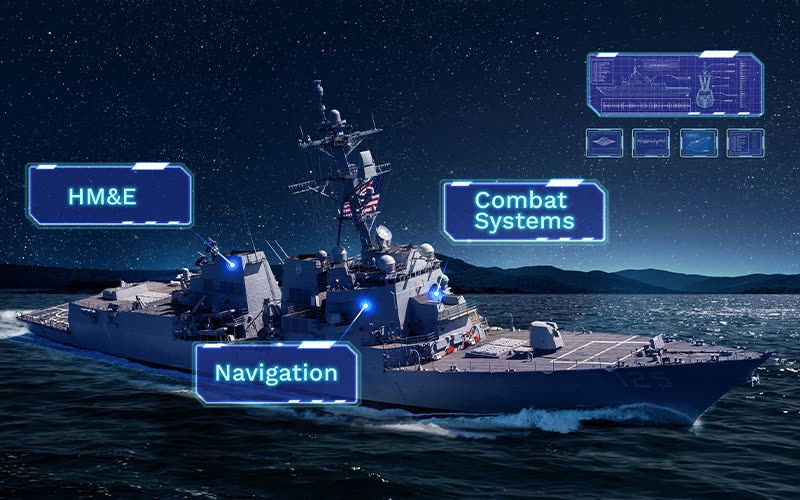
In the national defense arena, Situational Awareness, Boundary Enforcement, and Response (SABER) provides passive, out-of-band network monitoring and alerting, enabling shipboard systems to detect and respond to cyber threats, particularly to hull, mechanical, and electrical enclaves. As the SABER Program Office is expanding SABER’s footprint to fully cover the fleet, they’ve asked APL, as a technical direction agent, to spearhead the use of SABER in additional enclaves, such as the Navigation and Combat Systems Enclave.

The Navy-engineered SABER system, developed by APL with government and industry partners, provides frontline cyber defense for surface ships. It autonomously monitors hull, mechanical, and electrical (HM&E), navigation, and combat subsystems, detecting intrusions that threaten mission-critical operations.

The APL-developed More Situational Awareness for Industrial Control Systems (MOSAICS) is a vendor-agnostic, next-generation cybersecurity framework for industrial control systems. Developed to detect, characterize, and ultimately respond to cyberattacks in real time, MOSAICS was deployed operationally over the past year at key Navy installations in the continental United States and in the INDOPACOM area of responsibility. The framework was adopted as a baseline standard by the Office of the Under Secretary of War for Acquisition and Sustainment and was proposed for inclusion in DOW’s unified facilities criteria.

The Lab also released a new MOSAICS tool called BAS/CS — short for Behavioral Alerting Sets for Control Systems and pronounced “basics” — that standardizes alerts across diverse industrial control systems, enabling more consistent and rapid threat detection and response. With its common alerts IDs and unified correlation rules, BAS/CS reduces confusion stemming from varied vendor-system alerts and helps operators detect complex attack patterns more efficiently. Already deployed in the same military control-system environments as MOSAICS, the capability supports infrastructure sectors such as electricity, water, and natural gas — systems increasingly targeted by adversaries.

“Protecting the nation’s critical infrastructure demands a flexible ecosystem of capabilities that can meet the diverse needs of government and industry,” said Ray Yuan, APL’s mission area executive for Cyber Operations. “APL cybersecurity tools are designed to integrate across sectors and systems. This ensures that whether they’re working at a municipal water plant or a large industrial facility, operators have reliable options to detect, respond to, and withstand cyber threats.”

Portrait of Ray Yuan

“APL cybersecurity tools are designed to integrate across sectors and systems. This ensures that whether they’re working at a municipal water plant or a large industrial facility, operators have reliable options to detect, respond to, and withstand cyber threats.”

Ray Yuan, APL’s Mission Area Executive for Cyber Operations

In January, APL hosted Vista Gladiator, a weeklong wargame to examine the dependence of the military on private sector critical infrastructure, as well as the coordination needed among the military, government agencies, and industry partners to secure logistics operations from emerging threats.

Representatives from more than 50 public and private sector organizations took part in the game, outlining ways to prepare for and respond to a range of potential challenges, including adversary threats to infrastructure and supply chains as well as extreme weather events. A main objective was to ensure the agility and survivability of joint force systems, personnel, and operations, focusing on such capabilities as supply, maintenance, deployment and distribution, engineering, and contracting.

APL expertise was integral to enhancing the technical, scientific, and operational realism of the game and included the Lab’s insights on the national security aspects of transportation, food and agriculture, all-hazards and climatological effects, and counter-information operations.

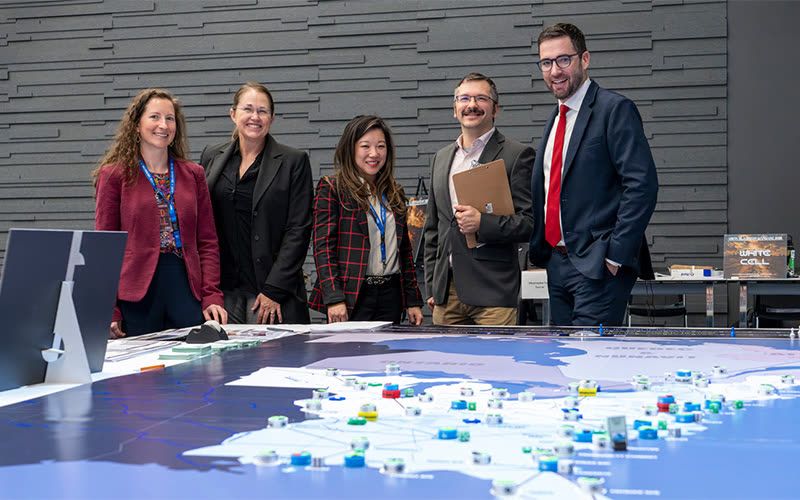
APL participants in Vista Gladiator included (from left) Lauren Ice, Kristine Henry, Liz Parkin, and Collin Timm, who were joined by Brian Hall, deputy foreign policy adviser with NORAD and U.S. Northern Command.

“Homeland defense has become even more critical as the threats have come to our shores in recent years,” said Liz Parkin, manager of the Resilient Critical Infrastructure program in APL’s Homeland Defense Mission Area. “APL can help frame critical challenges from many angles and through the eyes of many military and government sponsors, in ways they may not be able to see from within their own organizations.”

Vista Gladiator successfully called attention to gaps in authorities, priorities, technology, and funding among partners, and it revealed actions for improving national coordination across public and private sectors.

“This exercise allows us to practice, explore lines of authority, and get problems in front of the right people,” said Air Force Maj. Gen. Constance Jenkins, who heads the Logistics and Engineering Directorate for NORAD-NORTHCOM. “I like to call Vista Gladiator an exercise in ‘contested logistics’; we must be able to defend the nation’s and continent’s critical infrastructure, move commodities, and respond to threats in the homeland.”

Integrating Biology and Technology for Defense

APL is combining scientific insight with technological innovation to strengthen readiness and response in complex operational environments. Through military exercises and applied research, Laboratory experts are helping defense and public health leaders prepare for biological hazards, improve medical decision-making, enhance safety in the field, deliver tangible support to warfighters, and determine technical solutions to optimize detection, prevention, and response.

The Lab led planning and facilitation of Mālama Pacific, the first U.S. Army Pacific (USARPAC) biological defense tabletop exercise, signaling this as an increasing area of concern. Sponsored by the U.S. Army Nuclear and Countering Weapons of Mass Destruction Agency, the exercise focused on ensuring U.S. forces in the western Pacific could operate if confronted with biological threats — from naturally occurring disease outbreaks to human-made bioweapon deployment.

Drawing on knowledge of USARPAC’s mission and operations and relevant geography, APL served as exercise technical adviser and facilitator, presenting complex, challenging, and in-depth scenarios that challenged the Army and its partners to respond to a variety of biological incidents across multiple phases of conflict.

“Partnering with USARPAC gives our scientists and engineers the opportunity to deliver real solutions to real problems,” said Jeff Bacon, a senior scientist at APL who led the exercise facilitation team. “Exercises like Mālama Pacific allow APL to connect warfighters with cutting-edge research and technology, ensuring our nation can fight and win when faced with any biological incident.”

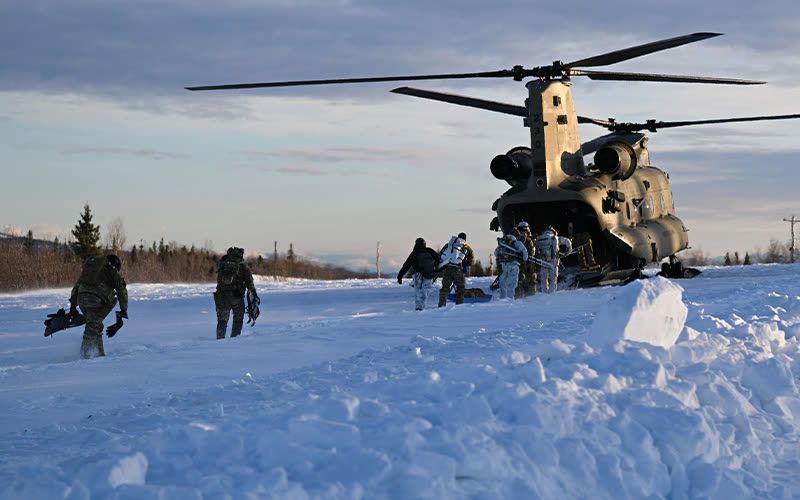
Participants prepare for Special Operations Forces Arctic Medic 2025, an exercise to strengthen readiness for medical and biodefense challenges in extreme cold-weather environments. At the symposium, APL shared insights aimed at protecting forces against various biological pathogens and chemical threats associated with Arctic operations. Credit: U.S. Coast Guard

Bacon also participated in an APL-led symposium in Alaska to help DOW prepare for chemical and biological threats in extreme cold weather. Held near Fort Wainwright and the University of Alaska Fairbanks, the symposium included stakeholders from NORAD, USNORTHCOM, and Special Operations Command North, as well as allies from Canada and the United Kingdom, and laid the groundwork for the Special Operations Forces Arctic Medic 2025 exercise.

Providing critical training and support, APL equipped attendees to identify and protect themselves against various biological pathogens and chemical threats associated with Arctic operations. Among the symposium’s comprehensive range of topics were natural, accidental, and deliberate biological threats, with particular focus on reemergent pathogens stemming from reductions in permafrost and ice sheeting in the Arctic region. The training included familiarization with field-forward diagnostics and detection approaches to bolster biodefense and below-zero medicine by providing actionable pathogen data in harsh, resource-limited environments. Participants shared awareness, best practices, and lessons learned in chemical and biological defense technologies and activities, strengthening regional cooperation, preparedness, and integrated deterrence.

Countering Chemical, Biological, Radiological, Nuclear, and Explosive Threats

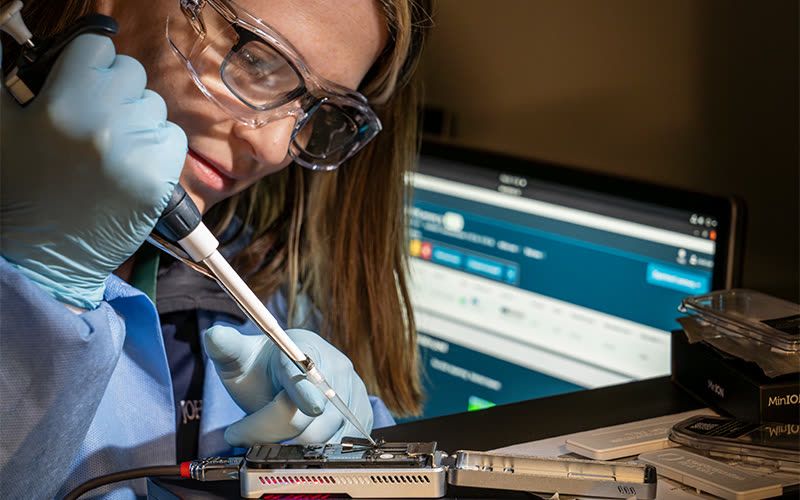
APL staff integrate laboratory-derived biological data with advanced artificial intelligence foundation models to uncover novel insights and improve predictive capabilities for biological research and defense applications.

APL is tapping innovations in sensing, analytics, and autonomous systems to help the nation anticipate, detect, and counter chemical, biological, radiological, nuclear, and explosive (CBRNE) threats — and give decision-makers faster, more accurate insight into complex hazards and response options.

As part of the DARPA-sponsored SIGMA+ program, APL assessed an early warning system for biothreats or disease outbreaks that uses wearable physiological sensors. Using advanced epidemiological modeling and analysis, researchers showed that wearable-based sensor networks that collect timely data from as little as 5% of a city’s population could identify the onset of an influenza season up to two weeks earlier than traditional public health surveillance and could also provide earlier notice of a large-scale, intentional anthrax attack. Earlier detection and geolocation of exposed individuals could dramatically improve the speed and effectiveness of response efforts.

Following the same strategy, APL researchers are developing tools that enable warfighters and forward-deployed investigators to analyze biological materials directly in the field. The Lab’s machine learning for metagenomics pipeline helps identify and assess microorganisms in collected samples. The system analyzes genetic data to classify potential threats into five risk categories, using statistical and machine learning models to detect even previously unseen organisms. Tested with real and simulated data, the tool achieved 95% accuracy in identifying threat clusters and is being prepared for field deployment, where it will give investigators near-real-time assessments to guide response decisions and enhance warfighter safety and situational awareness in biologically contested environments.